



Unveiling The Buyer Persona: The Key To Effective Marketing And Sales With Jim Kraus
I have Mr. Jim Kraus coming in from the Buyer Persona Institute. What is that? We’re going to talk about how you can know with certainty not only your ideal client but what they are thinking, what they value, what they want, and all of the things that make your job selling way easier. Please get a pen, a piece of paper, or a digital tablet. Pull over to the side of the road and please take notes on this. You’re going to love it.
To those of you who are interested in having us help you within your company or your independent sales career, please reach out to us. Whether you would like us to help you double your sales or do something else for the company, reach out to us at YouMatter@CEOSalesStrategies.com. Let’s go speak with Jim and welcome him in.
‐‐‐
Jim, welcome to the show. Thanks so much for being here.
It’s great to be on. Thanks for having me.
Buyer Persona Institute
Why don’t you tell everybody what you do and then we’ll set the frame for this?
I am the President of the Buyer Persona Institute. We’re focused on understanding buying decisions. We’re focused on trying to understand why buyers make the buying decisions that they do. Your marketing and sales practices and how you educate and influence buyers, you can take all the mystery out of that by understanding what they want to know and what they want to experience confidence in your products, services, and capabilities so that you can communicate and market with them effectively. That’s, in essence, what we do.
That sounds like a business owner, a CEO, or a sales team member’s dream. If I understand correctly, you’re helping people determine who wants to buy from them so that they can spend their time talking to those people and not talking to people who they think might buy their products and services and getting that ratio clear between the two. Is that accurate?
Yeah. I’ll put even another wrinkle on it. When you say the words buyer persona or customer persona, that’s something that’s thrown around quite a lot. It’s been around the “marketing industry” for quite a while. When you say buyer persona, most people think of a buyer persona as profiling a particular individual or role that’s involved in a buying decision, whether it’s a certain type of executive, IT buyer, etc. A buyer persona is a profile that describes who they are, maybe some demographics about them, maybe their priorities, etc.
The way we define buyer persona and the way I would encourage folks reading to think about buyer persona is a little bit different. Rather than understanding the individuals and roles involved in buying decisions, develop really deep insight into those roles and individuals’ mindsets and behaviors when they’re involved in a buying decision that you’re trying to influence.
If you’re selling widget X, what are all the things buyers want to know, experience, and have confidence in buying widget X from you? It goes beyond the individuals involved. It goes much deeper into how you impact, influence their behavior, and have them really trust you because that’s what they’re ultimately going to buy on.
Five Rings Of Buying Insight
Is it their wants, their needs, their desires, their fears, and all the things that make up their thought process on business return on investment, personal return on investment, and that kind of thing or is it something different?
You’re starting to get centered on this. One of the ways that we try to explain the framework for Buyer Persona is there are five key things that you want to know about any buying decision. If you sell XYZ product or service, whatever that might be, if you knew these five things, you would take all the guesswork out of your marketing and sales in terms of who you want to talk to, how you want to talk to them, and what you want to say.
The first thing you want to understand is what we call priority initiatives. Priority initiatives are triggers. These are the reasons that your prospective buyers are showing up at your proverbial door at this moment in time with some interest in this particular product or service you offer. What is the thing that’s getting them even started? What’s that triggering challenge or need or something that’s happening in their organization? The second thing you want to understand about this buying decision is success factors. Those are outcomes. What are the most important things that your prospective buyers want to achieve by buying your product or service? That’s the second thing you want to know.
The third thing that you want to know is what we call perceived barriers. These are a buyer’s fears. They’re concerns. What are the things that they’re worried about in this purchase? They’re doing something already. They’re going to move away from some type of status quo. What are their concerns about moving away from the status quo? What are their concerns about selecting a particular product, service, or provider? You want to know what those concerns are because if you know what they are ahead of time, you can proactively address them and instill confidence in your buyers. That’s number three.
Number four is decision criteria. The way to think about decision criteria is that these are all the questions that your buyers are going to ask as they evaluate who they are going to consider and how they will dwindle down their alternatives and make a buying decision. This is when you’re getting into the nuts and bolts of product, service, features, capabilities, and all those kinds of things that buyers make a decision. If you knew that ahead of time, that would have a huge impact on your marketing and sales.
The fifth and final thing you want to know is what we call a buyer’s journey. There are three things involved in a buyer’s journey. One is, who are the key influencers in this purchase. Number two, what are the information sources that they’re going to use to get informed about this decision that they’re making? How are they going to educate themselves about the alternatives and who’s out there?
Finally, what are the steps in their process? What are they doing to go through this buyer’s journey? Are they doing web research? Are they talking to their peers? Are they doing trials right if it’s something like a technology solution? If you know those five things, and we call them the five rings of buying insight, think about how much you could focus your marketing and sales, what’s important to buyers, and what is going to significantly improve how much they trust you and your solution.

Ideal Client Profile Vs. Buyer Persona
I love these five things. I want to step back. When people are learning this, you need an ideal client profile. For those of you who are not aware of what that is, they call it ICP usually for short. Let me step back and ask you – what’s the difference between an ICP and a buyer persona?
ICPs are great. ICP is more focused on the who. What are the types of individuals or roles? If it’s a B2B decision, what are the types of organizations that you’re targeting? These ICPs are your Ideal Customer Profile. These are the people in organizations that you’re ideally targeting because you feel like they are well-aligned with your capabilities and how you differentiate yourself. You feel like it’s a really good fit.
To build your buyer persona, what you want to do is you want to go to companies like that or individuals like that if it’s a personal buying decision. You want to do interviews to understand all the things that I mentioned a moment ago, those five things. You’ve got your ICP. You’re like, “We’ve decided who we’re going to target. Now, we’re going to develop a buyer persona,” based on the buying decision that you’re trying to influence with that particular individual organization. They go hand in hand. The way to think about it is ICP is who you’re going to target. Buyer persona, the way I’m defining it, is what’s the mindset and behaviors you want to know about your ICP so that you can communicate, market to them effectively, and build their trust.
This influences everything from initial reach out to messaging to addressing objections upfront. This sounds like understanding them completely before or at least 80% before we get and have the conversation with them.
You’re 100% percent right. A marketing director we had worked with years ago told us it’s like getting the answers before the test, which I use all the time because it’s very apropos here. That’s what you’re trying to do. Think about it. You’re spending all this time, effort, and money on marketing and sales. You shouldn’t have to guess what is going to resonate with your prospective buyers. There’s no reason to guess. You can go out and talk to buyers who have made these buying decisions very recently and get all these insights from them by talking to them. You can eliminate all those guesses and you’ll see your ROI go up exponentially from your efforts because you’re connecting with them.
Talking To Buyers
I’m talking to my buyers. I’m getting all of this extremely important information, so I’m not winging it anymore. Do I normally do it with the recent buyers or would one go back to future buyers and interview them or past buyers and interview them as well? What’s the best out of the three?
Let me define recent buyers. Recent buyers are individuals. It could be a personal buying decision or it could be individuals in an organization who were involved in the buying decision. They were part of the evaluation process. These are folks who have made the exact same buying decision that you’re trying to influence in the past 3 to 12 months.
They’re not necessarily your only customers. In fact, we would strongly encourage you not to talk to your current customers. You should be talking to buyers who have made this type of buying decision and have never considered you. You should be talking to recent buyers who made this buying decision, maybe considered you, and selected somebody else as well as your own current customers.
The reason for that is if you understand all those different points of view, you have a buyer persona that’s going to be representative of your target market, not just your current customers who have already selected you. There are already some biases in there. They’ve already decided on you. You want to talk to other people as well. They are the experts because they have gone through that buying decision.
If you’re selling widget X, interview somebody who bought widget X in the past twelve months. Talk to them for 20 or 30 minutes and understand all the different steps they took from the moment there was an initial trigger for your particular product or service all the way until they made a final buying decision. Question them, probe, and get at each of these five errors that I mentioned. That’s the way to do it.
Perceived Barriers
We’re speaking to Mr. Jim Kraus, the President of Buyer Persona Institute. They’re at BuyerPersona.com. I highly recommend you check this out. I am a huge proponent of this process. The reason I’m so hyped up on this particular concept is because when I didn’t know what I was doing way back when I started out, I had an offer that wasn’t converting at the percentage I wanted it to convert. We had a telecommunications consulting auditing firm. We would audit people’s phone bills, keep them on the same carrier, and reduce their phone bills without changing carriers. 24.5% percent was the average conversion rate. My brain went, “Why wouldn’t somebody say yes to this?”
We went out on the initial pitch and were like, “We’ll reduce your phone bills.” That was the message. We got 1 in 5. I was like, “Why? I can’t figure it out. It costs them nothing. If they’ve got a $10,000 monthly phone bill, they drop it by almost $2,500 a month. That’s $30,000 in profit to the company right off the top.”
I couldn’t figure it out, so one day, I was like, “Why don’t I go talk to the people who bought and the people who didn’t buy?” You said recency. I asked them and they gave me an answer. That answer was, “We love the concept. However, we’re afraid you’re going to knock us out of service because anytime we’ve ever changed anything on our phone in the past, the carrier messed it up and knocked us out for a couple of days. We’d lose more money than we would gain.”
They gave me the top five reasons in order of priority. I said, “We’ll create a process which will guarantee 99% this will never happen.” We laid out the information on our website. When we called, it wasn’t the same message. It was the message about, “Would you like to safely have a 99% guarantee?” Our close rate went from 20% to 71%.
The reason I’m bringing this up is I want people to understand that what we’re talking about is powerful. It also means that you can work smarter, not harder in your day because you can close more sales going after the highly qualified sales-ready leads versus generating a bunch of leads or marketing qualified leads and then having to nurture them all the way up to the funnel. That takes time, energy, and money.
There are a couple of important things that you said. The third area of insight we talked about was perceived barriers. I mentioned to you that these were fears and concerns. You identify the critical one for your particular offering. It’s incredible because there are two sides to a sale. We see this all the time. You’ve got buyers that want certain outcomes. They’re making an investment in your solution, whatever it is, and they have certain expectations about what they want to get out of that.
What you have to make sure you understand is what are the things they are worried about going wrong. It’s called the fear of messing up. There are a lot of empirical studies done on this. It’s pretty powerful. People are afraid of loss. You have to understand what those are.
People are afraid of loss. You have to understand the things they are worried about going wrong. Share on XHere’s another great example for you. We did a study for an endpoint security software company a few years back. It’s software that you put on your PC, your tablet, etc. that helps prevent malware. Everybody has that on their PC. They had targeted large global enterprises for years quite successfully. They said, “We’re going to go downstream to focus more on the mid-market and smaller companies.” It’s a common thing to do.
They were all excited about it. They said, “We’re going to position ourselves so that we can provide small companies with enterprise-level security.” They were excited about it. They were like, “Who wouldn’t want this?” They felt they even felt good about the price point, but their sales were not great. They weren’t converting business and they didn’t know why.
They went out and did a buyer persona. They went out and interviewed recent buyers who made this decision. What they found was that the mid-size companies, particularly the smaller ones, were happy to get the enterprise-level security. That was good news for them. What they were most worried about was that the software was going to be put on their systems and it was going to slow everything down. It was going to eat up all their technology resources. It was going to slow down their transaction speeds. It was going to slow down pro key processes. They were going to lose revenue as a result.
They made a really small change to their positioning and messaging about how this software will provide you XYZ security, won’t hog your resources, and won’t slow you down. Their sales tripled from a small, tiny little tweak. Buyer personas are really powerful. The nice thing about them is the insights are so pragmatic that you’re going to start using them immediately because you’re going to say, “This is what I need to do to make my buyers feel confident and secure that I’m going to deliver for them.” What a wonderful thing. That’s how you convert business.
Messaging has become so much easier. My wife and I have a great relationship. Once in a while, we joke like, “You’re thinking like you, not like me.” What we’re talking about is thinking like the other person and coming in with messaging that is congruent with what they want to hear and what they’re looking for. The concept is not very difficult to understand here. Maybe the construct of it is a little more involved.
Why Businesses Are Missing Out
I have a question. Why doesn’t everyone do this? It perplexes me. You mentioned an enterprise client. I worked with an enterprise client that is well-known. We would know the name Intuit in a heartbeat. They had a messaging issue with one of their divisions. We did something similar but we didn’t have it as structured as what you have. I love what you put out and put forth.
They went from a $10 million loss to a $7 million gain in 1 year on us changing the messaging based on what the buyers previously had told us. They thought we were great. To me and to a guy like you, it seems very obvious, but when I talk to company owners, independent sellers, or salespeople, they don’t know this information the way you’re speaking. Why do you think that is the case? I don’t have the answer. I’m curious about your perspective.
There are a number of factors involved in this. Every day of my life is spent on this issue in terms of trying to convert business ourselves and have people do this to benefit their organizations. One of the things that I come across quite a bit is I deal with a lot of marketers in corporate organizations, small, medium, and very large organizations. One of the challenges is marketers are being asked to do so much. They’re almost like hamsters in a wheel sometimes where they’re constantly being asked to help develop pitch decks, help Salesforce with XYZ presentations or talking points, or, “We need to update our website,” and then that becomes the activity itself.
What happens is it gets hard to sometimes slow down a little bit, take a beat, and think about it from a marketing and sales perspective. Anybody who touches business development in any way, is thinking for a second what you are trying to do with all this activity. The key thing that I emphasize, and a lot of times when I give talks, I spend half the time talking about this before I even talk about buyer personas of the framework, is you are trying to influence a buying decision, particularly when you’re talking about a high consideration buying decision. It is one where a customer is looking at multiple options.
They probably haven’t bought this before. They don’t buy it very often so they need to get educated. They’re nervous about certain things. They’re worried about the risk of things going wrong as much as going up. You could put yourself in the buyer’s shoes. Empathy is what it is. You think to yourself like, “I’m trying to influence this individual whether they’re within an organization or not.”
Put yourself in the buyer's shoes. Empathy is what it is. Share on XWhat I’m trying to do is make them feel solid about this decision. I’m trying to make them feel like, “If you buy this, you’re going to get all the outcomes that you want. Nothing’s going to go wrong. In fact, it’s going to work out great for you.” If you stop and think about that for a minute, it changes the game a little bit because you’re spinning stuff out and always saying to yourself, “Is this a thought leadership piece? Is this a sales presentation?” etc. Unless you’re nailing exactly those points that are going to build buyer trust, then what’s going to happen is it’s going to be white noise. These buyers have all this information coming at them and all you’re doing is confusing them more than helping them.
That’s one of the biggest things. When I talk to marketers, I spend a lot of time getting them to think through that a little bit, and then the framing that I lay out becomes a no-brainer. They’re like, “That makes total sense why we would want to go do this. Now, we’ll have all the answers to this.” What’s going to happen is you’re going to feel the wind at your back. Instead of facing a headwind, everything will flow a lot easier in your marketing and sales.
Folks, I want you to write that one down, the wind at your back. It is so much easier when you have the wind at your back than it is in your face. I wrote down that it’s a lot easier to influence than it is to persuade in a sale. Lean in because what Jim’s saying is, “Let’s work in a leveraged way up front and the rest will follow naturally.” To those of you who are selling or marketers, would you rather influence or have to persuade someone? It’s a lot easier to influence somebody when you’re influencing them on something that they already want and they told you that is the case.
Resources
I want to go back to the website because one of the companies I owned in the past was an SEO company. It would’ve been a heck of a lot easier to do keyword research if we had the buyer persona down and had all of this down. That website would be far more effective in search. To those of you who own a company or marketers, please take Jim’s advice and do the buying persona or the way you’re telling them to do it because it makes so much sense. Didn’t you write a book or something on the subject of buyer persona?
Yeah. Adele Revella, which some of your audience may have heard of, was the Founder of Buyer Persona Institute many years ago. She wrote the first edition of the book called Buyer Personas which came out several years ago. It was regarded by Fortune Magazine as 1 of the top 5 business books that year. She and I co-authored a revised and expanded edition that is coming out on July 30th, 2024. It’s called Buyer Personas, Revised and Expanded. It’s available on Amazon, Barnes & Noble, etc.
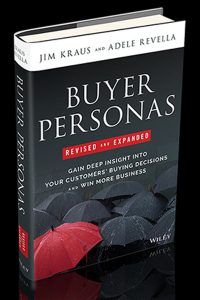
We wrote the book because it’s been years since we wrote the last one. A lot hasn’t changed. A lot of what we talked about has not changed, but there are a lot of new things to talk about in terms of things that we want to emphasize about the buying decision, some of the things we talked about, and how to make marketers and salespeople appreciate that a little bit more.
We also added things to the book about how to do a buyer persona study and step by step how to do it. We showed in this version an example of a buyer persona study, what the outputs look like, and what are all the things that you get. We then added some additional information about how you can use AI to help enhance your buyer persona and how you can do things like survey research and some additional things. The last thing we added, which we thought was really needed, was even more content about what are some key things to do with your buyer persona once you develop it. We’re pretty excited about the book coming out. It was time to do it for a number of reasons, so we’re pretty excited about it.
Can people get that on Amazon or by buying it directly?
It’s on Amazon.com. It’s on BarnesAndNoble.com.
Some are probably sitting there dazed and confused, thinking, “I should have been doing this forever.” Some of them might even be crying on the side of the road and cursing that they tuned in to this show and my name, but the outcome’s still the same. Some people are going to want help doing this. Where do they go? How do they know more about this or you and contact you?
BuyerPersona.com is our website. I encourage you to go there and learn more. We try to put out a lot of thought leadership blogs. When we participate in shows like this, we post them there. We’ve got templates there. We also offer a masterclass, which is a self-paced online class. You can take it yourself if you want to do something like this yourself. You can also click the Contact Us button on that website. We’ll be happy to talk to you about partnering with you to do a study like this if you want.
The other place I would encourage you to go if you have an interest in any of these topics is LinkedIn. Link with me, @JimKraus. I’m always trying to put stuff out on this topic and about understanding and influencing buyers in general. That’s another great resource if you’re trying to get this a little bit more in your mind stream, so to speak.
Thanks so much for being here. I really appreciate this. This is so valuable, this information, for people not just to have but to take action on this. Great information without implementation, you’re knowledgeable but that’s not going to move the needle forward for you the way if you take action on this information. Thanks again for being here.
I appreciate it. Thanks.
‐‐‐
I got a whole page of notes. How about you? Did you remember all those five criteria that are critical, the priority initiatives, and the success factors, if you will? What are the outcomes? What are the barriers? Isn’t that a cool thing to understand? If you want fewer objections, understand this right upfront. Number four is the decision criteria. What are the questions that are asked that help bring this toward a decision that’s favorable for them? The buyer’s journey is broken down into 3 stages or 3 steps.
I can concretely tell you that what Jim was teaching you on this episode works. I had to learn this. I learned this by accident in the beginning because we didn’t have a big marketing budget. Back then when I started out, we couldn’t afford to do certain things like create a focus group where you can get people into a room and talk to them about their buying criteria. All of the buying criteria information you can get upfront is going to help you. As Jim said, put the wind at your back versus the wind in your face when it comes to running your business and growing your sales.
If you are looking for help to grow your sales or even double your sales, reach out to us at YouMatter@CEOSalesStrategies.com. That is an email address. Send us a message and we will get back to you. Until next time, go out and sell something, and sell a lot of it. Play win-win. Make someone happy. Make sure they win and you win. It’s the best type of sale. Sponsors and referrals do all kinds of great things for your life. If you love this show, I’m going to ask you to please give it a review. Until next time, to your success.
Important Links

