



Cultivating Excellence: How Company Culture Breeds Revenue Success With Tom Willis
I have Mr. Tom Willis from Phoenix Performance Partners coming on the show with us. We’re going to talk about how to create exceptional culture in your day, your life, your company, and your world, and how that translates to either revenue increase for you and making it easier, or how it translates into the other side, which you don’t want to go into. We’ve all experienced something where we had this great, amazing outcome where we’ve been in whatever it might be, a consumer buying or a business-to-business buying scenario where we go, “That was easy. That was great. These people care. I trust this.” That is an exceptional culture because it’s been crafted from a vision, and that vision has been pushed forward and through the organization and people have been allowed to engage and have aspirations and build upon that.
Even if you’re a one-person army and you create that, you still have back end that goes on after the sale. If it’s created through the organization, it works amazingly. We’re in 2024. That’s even better with everything that’s going on, where most companies are trying to do more with less, and they’re pulling back on the actual communications and the engagement of the process. If you do it in the opposite, you will stand out. You want to be more, stand out in a competitive field. If you do this, people talk about you. Tom is an expert at doing this. Let’s go and talk about how to create an exceptional culture for you.
—
Tom, welcome to the show. Thank you so much for being here.
Thanks for having me.
I know you’re up in the sunny, warm area of Detroit, Michigan as at the time of recording, we’re coming out of the winter into the spring. Why don’t you tell everybody what you do, what your company does, and let’s set the frame.
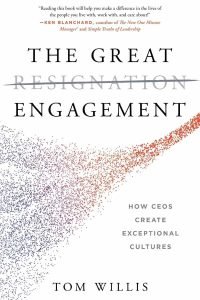
I’ll try to keep it brief here. At the highest level, we work with CEOs across the country and around the world, helping them create high-performing cultures and teams. We’ve been doing it for many years. We are pretty unique in that we promise results. We have a guarantee that we make with the CEOs, which is pretty unusual. A few months ago we released a book called The Great Engagement: How CEOs Create Exceptional Cultures. There’s a lot of good stuff in there as well that if folks are interested in this work, it is maybe a good place to start.
Many years in business. That’s longer than most people have ever been in business. Congratulations, and let’s talk about the great engagement. Firstly, what is an exceptional culture? I think that’s probably the best place to start.
With a lot of folks that we work with, the first step is to let in the idea that they can be exceptional because many of us have this critic in our head who’s constantly telling us, “We’re not good enough. We’re not smart enough.” We’ve got the imposter syndrome. I was a CEO at the age of 34 and had a couple of hundred employees. If I’m honest with you, for much of that time I was doubting whether I belonged there or not. The first step is to open up the possibility that you can be exceptional, which means outside of the norm above average in a way. Do you want to be in the top 30%, 20% or 10%?
Let in the idea that you can be exceptional. Share on XWhat do you want to be in the top 10% of? Do you want to be the most exceptional at producing profits or do you want to be the most exceptional at producing outcomes for your patients? If you’re in the education space, what does that mean for you? Slowing down to think about it, because many of the best leaders in my opinion anyway, are very humble. They’ve got a great sense of humility. The problem is we look at humility sometimes in a not terribly productive way. We look at it in a self-limiting way. There’s the great Hebrew word, anavah, which is where the word humility stems from. Anavah means to take up your God-given space in the world, which is interesting, whether you’re a believer or not, to think about the concept that we’re meant to be humble means to take up the space you’ve been given.
If you’ve been given a lot, if you’ve been given the opportunity to be a CEO with a few thousand employees, then don’t play small, but also don’t play bigger than what you’re given because that’s your ego kicking in. That’s not helpful, and no one likes that. It’s figuring out what the space that you’re supposed to occupy. Once you’ve figured that out, then you’ll be likely to produce that much more productively and be much more engaged in your team, and therefore your team’s more engaged.
That’s a fascinating definition to me because it almost sounds like humility is and takes up the space that you’ve been given. It sounds almost the opposite to what humility is. Most people have the definition of it, but I love the definition of it. I have a question. I don’t know if you know the answer to this, but it sounds to me like creating a vision for yourself, and people, knowing where you want to play, what level you want to play at, and knowing the space you’ve been given to take that up is important. Why is it difficult for most people on this planet, never mind CEOs, but everybody across the planet to have a clear vision for themselves and then they can have a clear vision for the people in the organization? Why is it difficult for people to have a clear vision?
Many of us spend more time planning our vacations than we do our lives, which is funny and sad because it’s a little bit true. I wish I had a good answer for that. It gets back to a great study and some insight by lots of different folks. We’re learned so much about the brain over the last few decades. There’s this great quote from Timothy D. Wilson, the University of Virginia. He talks about how the human mind can process eleven million pieces of information at any given moment. That’s unbelievable. We could be conscious of about forty of those. 40 out of 11 million, even if you think those numbers are wrong and you cut them in half and double the 40, 80 out of 5.5 million is still not great. What that gets to is that we are mostly unconscious beings.

I’m sure many people are listening to us saying, that’s a bunch of BS. I did the same thing. I dismissed this idea when I first heard it about many years ago. What I’ve come to realize is that even though I’m an engineer – I have an engineering background, I’ve got an MBA, I’ve worked with some huge companies like Intel and PricewaterhouseCoopers, and I’m not as rational or not as thoughtful as I think I am. Most of what I do as well is at an unconscious level. I’m just doing what I do because it’s worked for me for decades. One of the hardest steps there is to slow down and to get more conscious to think about your thinking. That can be a little bit exhausting, frankly. I think that’s why most people don’t do it, because it can be more tiring than going and doing, reacting and trusting your intuition all the time. Because that’s easy and quick.
Firstly, I got to tell everybody, and Tom, you and I when we talk every once in a while, we joke a little bit, but the average person, 11 million thoughts can process 40 consciously at one time. I’m way below the curve because I can process 1 or 2 at a time.
It’s not a bad thing too. If you think about it, the act of driving a car is unbelievably complicated. If you think about everything that has to happen down to the rate at which your heart is firing the blood through your vessels, and the muscles that have to engage to turn the wheel or to press the brake or to turn the turn signal and throw on top of that, maybe talking on the phone while you’re driving, listening to music or having a conversation, you can quickly get to why there are all these things happening.
This is not a bad thing. This is a huge gift that we humans have been given. It’s, “What are the 40 things that I want to be conscious of, especially in the context of leadership?” Because we are all CEOs of our own lives. We’re all the chief engagement officers of our own lives, and it’s up to us to create more engaging lives. We don’t get to blame other people.
We are all CEOs, the Chief Engagement Officers of our own lives, and it's up to us to create more engaging lives. Share on XIf we are the CEO of a company, which most of us here are, or we are selling for a company or we’re an independent seller of our own company, I want to create a vision. I’m going to stay on this point if you don’t mind, because I talk to people all the time. One of the things that I do to help people double their sales is to get them clear on what the heck they want in the first place because most people don’t want to double their sales even though they can. What they want is living a life that’s above where they see themselves being able to live financially so that they have a cushion and that they can go out and enjoy some luxury items without feeling guilt, feeling stress or be able to do something for somebody else.
It’s very rarely about themselves. That’s what I’ve found, but they don’t feel they deserve this vision and that’s why I asked the question. And you talked about think about your thinking, I like that angle. I’m going to ask you a question. Do you think that people can’t clarify what the vision is? And we all know as CEOs of companies, if you can’t give the vision to the people, the people are going to run the vision in the way that they think they’re supposed to run it. Do you think that a lot of people have imposter syndrome or they feel they’re not good enough because they were brought up in a certain way? I was brought up in a household where you were good but you were never going to be good enough.
It’s like, “We’re great musicians, all of us in our family, but to be Bon Jovi, it’s not going to happen.” That type of mentality. I had to wrestle with this most of my life until I became conscious about what the vision was, and that happened when my first daughter was born. Sometimes it’s a trigger that I find. When she was born, it was like, “Who’s going to win, the upbringing or your daughter?” I had to go through that battle in my head, and she won, hence I won. I was able to get clear about what I wanted in my life. Do you think that maybe it’s habitual scripting from an early age that gets people to this point where they go, “I’m unclear,” or worse yet, “I got 4,000 things I can focus on and I’m good at 200 of them so I’ll try all 200 at once.” What do you think?
I’m not a psychologist so I’m not qualified to probably answer that question at any great depth, but I can point to a couple of ideas and resources that might be helpful for those folks out there reading. One is a book called Mindset by Dr. Carol Dweck. It’s a fascinating inquiry into the mindsets that we have and a little bit over-simplistic, but it boils down to whether we have a fixed mindset or we have a growth mindset. The reality is we don’t. I don’t think anyway. It’s either/or. There are things in my life where I’m pretty fixed and there are areas where I’m very growth-minded. I try to be growth-minded about almost everything in my life, but I know that’s not possible. Whereas other folks are fixed about most things in their lives and they don’t think growth is possible.
In fact, you’ll hear people say things like, “That’s the way I am.” That’s a dangerous saying, especially in the context of leadership, especially if you’re the CEO, that you don’t get to be a certain way. You don’t get to be X, Y, Z because especially nowadays, your people need more from you than the one way you always are. You have to be adaptable, you have to be agile, you have to be able to respond to an overly increasing and changing world, which means we can’t just be one way. A lot of it goes back to certainly childhood and early childhood memories, and a lot of these things get locked in at a pretty young age, but it’s not an excuse necessarily for staying that way, especially as leaders.
You said the most humble thing on the planet, “I’m not a psychologist, but I’m going to give it a shot,” and there’s huge power in how you presented that. I loved at the end here, you’re like, “We’ve all had some issues growing up in some capacity, but it’s not an excuse that we can rely upon that as that’s the reason we’re not moving forward because we have a growth mindset or we have a fixed mindset.” Let’s say that we all agree on this line right now. I want a growth mindset. I want to create this amazing, exceptional culture in my company because, between you, me and the lamppost, we all know if you have a great culture, you’re going to sell more anyways and your company’s going to grow.
It’s study after study, 30 years on your side, 30 years on my side, we’ve both seen this happen where we go into companies that we go, “There’s something different here. No wonder they’re growing.” It usually comes down to that culture and the leadership that created the culture. Let’s say everybody says, “You got me. I want to create this exceptional culture in my company. What do I do first, call you? What do we do?”
We are happy to talk and try to be helpful. We don’t sell our services. We offer them. Some people like what we’re offering, and some don’t. I’m happy to do that if that’s helpful to folks. The book is a great resource. I don’t mean to say that in a way that’s bragging. My business partner and I have been doing this for over 30 years and we tried to pour our collective experience into the book as best we could so that people who couldn’t hire us, couldn’t afford us whatever, had access to a lot of the core ideas. There are some fantastic tools in there. We talk about distinctions between things that are obvious, but people don’t know what they are like leadership, management and coaching, for example.
People don’t know what those things are. We try to explain them and unpack them in the book in a way that’s accessible. That’s a great place to start. The biggest place to start is a simple question. It gets back to your point, “What do I want? What do we want as a team?” We try to simplify things as much as we can. Our book, we worked hard not to put a bunch of jargon in there. We tried to simplify as much as possible. As an example, we said that The Great Resignation has been going on, it technically ended 2023. The statistics say that it ended in 2023, but from what I can tell, it has not ended. People are still very disengaged.
In fact, Gallup released an article about two weeks ago saying that engagement within organizations has reached an eleven year low. It’s down to 30%, 30% of employees are engaged. That is sad, plain sad that we got 70% of the people out there, “Eh,” about their jobs or actively looking for a new job. It’s a pretty, pretty sad time we’re living in slowing down to say, “What do we aspire to? What is it that we’re going for?” we think engagement is the antidote to resignation. If I’m engaged in something, then I don’t need to be convinced. I don’t need to get buy-in. We break down the formula of engagement to two things. Aspiration plus empowerment. Aspiration is important. It’s first and there’s a big difference between aspiration and inspiration.
Inspiration is awesome. It’s very necessary. You need it as a leader. You need to inspire your people at times. Ultimately, if you can get your people to have their own aspirations, meaning their own vision of the future, what they want, and you can map that onto the organization’s purpose, that’s unstoppable. Aspiration is intrinsic, then empowerment’s pretty straightforward. If I feel empowered to do my job, if I’m empowered to do things in the way that I think makes sense, it doesn’t mean it’s the Wild Wild West by any means, but if I feel empowered to do that, then I’m going to be engaged in my job. We think this simple formula works 99% of the time.
I’ve experienced this. We took a trip to Europe and we’re on our way back and we’re in Ireland and we’re tired from jet lag and traveling and all this stuff. We’re like, “We’re going to check our bags.” We’re flying on JetBlue. JetBlue, if you read this, pay attention because what you said, Tom, I experienced this because aspiration and empowerment, those two, that equals end result that your client will experience from that individual. That’s what I get out of that process. Do I have this right? If somebody’s engaged and aspiring, then it’s going to translate into some type of better outcome for the client engagement.
If you think about it, every good organization, I don’t care what you do, is rooted in this idea of a good engagement because ultimately it’s about providing value to those you serve. It’s that simple.

In my example, true life, we get to the airport, we’re tired, it’s early in the morning. We’re going to check our bags. JetBlue, your website’s terrible for client engagement. That’s my opinion. We get to the airport, we stand in the line because we’ve got to bring our bags forward. Most of my life, when you check your bags in, you bring them up to the counter, they grab your bag and they check it in. We go through this whole line, get there, and the person says, “You don’t have your bag tags.” I’m like, “What’s a bag tag?” He was like, “You’ve got to print them out.”
I’m like, “Don’t you do that here? That’s what people have always done. They print the bag tags out here.” “No, you’ve got to go to the kiosk.” “Where’s the kiosk?” He points to the corner. The kiosk is 300 or 400 feet from where he is sitting. I’m like, “Can’t you help us out?” “I can’t do anything. Next.” It was that type of treatment. I was thinking right then and there, “I’m done with JetBlue.” We go over to the kiosk thing and we can’t figure it out. We’re pushing the buttons and the machine’s going, “Sorry, we can’t help you here.” Now we’re getting frustrated beyond. I’m thinking, “American Airlines is right over here. Let’s cancel this flight. Let’s jump on American Airlines and go home.”
A gentleman must have noticed us and he came up and goes, “Can I help you?” I said, “Sure, this is what’s going on. Your machine’s broken. I don’t know.” Long story short, he goes, “Our machine’s broken. Go back to the line and tell the guy that he needs to print your bag tags.” I’m like, “He could have printed my bag tags right then and there?” He goes, “Yes, but we have this policy set up that you got to come here first.” I said, “It’s a ridiculous policy.” He goes, “I agree. Tell him a manager says he has to do it, otherwise he won’t help you.” Literally, this is what the guy is telling me. I go back and I say, “Patrick said please print my bag tags because your machine’s done.” “Sure, no problem.”
That’s an example of what I heard you say. Now my experience is I’ve got another flight on JetBlue this fall. I’m canceling it. That’s a loss in income. That’s a loss in revenue. Never mind the fact that I’m telling you and probably, 40,000 or 50,000 other people who are going to read this thing, my experience. Is this what we’re talking about? When you create an exceptional culture, you have other stories that aren’t like the guy Patrick, hail to him. The company in general suffers when our culture is not aligned with what we’re trying to communicate to the end client.
In that case, you’ve got a disempowered frontline it sounds and he can’t do anything until Patrick tells him to jump and tells them how high to jump. It’s sad, but it happens to lots of organizations as they grow. Because you layer on more layers of process, procedure and policies instead of slowing down to say, “We have perfectly mature, capable human beings here that we need to bring into the fold and get them engaged in a way that they’re enabled to be empowered to make things happen for our customers.”
I get my vision down, I want to be in the top 2%, 10% or whatever it is. What’s the next step? How do I empower my people? How do I get them to be aspirational and empowered?
Before we get to a pragmatic step, we’ve got to back up a step a little bit. I was walking through the Salute Game Reserve over in Southern Tanzania, Africa. It’s the largest game reserve in the world and it’s about 19,000 square miles. It’s unbelievable. We’re out for the day doing a safari with my best friend. It’s a long day. It’s hot there. We’re coming back, we’re exhausted and we’re going through a small patch of forested area before we get back to the lodge. We’re half paying attention. We’re all in a single file line following the leader who happens to be carrying a machine gun to keep us safe.
All of a sudden I hear this scream and then boom, someone hits me in the face. I fell back and hit the person behind me. We all stumbled to the ground. I came to find out from the two people in front of me that the leader with the machine gun almost stepped on a black mamba snake. For those of you who don’t know, the black mamba snake is considered the two-step snake because if you get bit by it, you have two steps and you’re likely dead. It is the most feared creature, at least among this group of folks that we were in that part of the world. It is even more fearsome than the lion or the rhino because of this.
That moment right there was a fear-inducing moment, the amygdala, these two almond-shaped objects behind our ears and our brain detect novelty. They detect something new, they kick into action, they fire cortisol, we react out of fear and we back up. In his case, he lept backward in a way that sent all of us leaping backward. That’s a good thing. Fear is a good thing in that context. The challenge is nowadays in 2024, in most workplace cultures, we don’t have black mambas, but our brain, our amygdala more specifically reacts to somebody’s email, the way somebody looks at us, the fact that they didn’t copy us on the email, somebody’s tweet or somebody’s post on Facebook.
We react to those things as if they’re black mambas. It’s completely disproportionate to the actual threat. In fact, in many cases, they’re imaginary threats. We make up a reason for why that person didn’t do something. We confabulate these stories in our heads. I tell you this story because this is what we’re dealing with. As leaders, we’re dealing with ourselves first and foremost, and our fears and other human beings.

If we want to be effective at leading, we have to realize that we are emotional beings. Whether you like that or not, whether you believe it or not, doesn’t matter. It’s true. We need to know what that means for the context of leadership. We have to be responsible for, at the end of the day, shaping human emotions to help people to transform their thinking and not react in certain ways to certain things. This is where it starts to get a little bit, not hard, but more intentional. We have to be much more intentional in our leadership and we have to be much more thoughtful about how we engage people. When we start to look at change and we start to look at improving things, what we’re up against is people’s amygdalas. People saying, “We can’t do that because that makes me uncomfortable. We can’t do that because we’ve always done it this way before.”
To realize that what I’m dealing with is somebody’s deep-seated fear, and that’s where I have to start – I have to be aware of this. I don’t have to empower it. I don’t have to spend time there. I don’t have to baby my people. Knowing that that’s what I’m up against is an important first step because the job of leadership, I think is to transform our thinking from fear-based to much more love-based. I don’t mean Valentine’s Day love. I mean they love to provide benefits to others, to put others first, which again is what any good organization does, is they put the customer, they put the client, they put the patient first. When you can do that effectively, you’re no longer focused on yourself and your own fears. You’re focused on being of service to others. That’s what makes, in simplistic terms, amazing cultures.
Focusing on being of service to others makes amazing cultures. Share on XThat was well said. I don’t think we need to go any deeper. This is my personal thing, if you can do exactly what you said on the love base and get the end client to the point where they feel what you said and they also feel that it’s Valentine’s Day love, that the company loves to do business with them, that creates such a bond of trust between the company and that individual. That’s what creates loyalty in many cases in the process. I can’t add any more to that.
That was perfectly said. sure people right now some of them are, are like smiling and some of them are, are going, oh my gosh. Some of them are probably crying, pulling onto the side of the road going, “I’m not doing this.” How do they get ahold of you or learn more about you? I know the great engagements, the book, but you know, Phoenix Performance partners at PhoenixPerform.com is the website, but how do they know more about this? It’s such an important subject that people need to know more about.
We’ll put together a specific landing page for this show because we do quite a few of these that hopefully are helpful to your audience. It’s www.phoenixperform.com/ceosalesstrategies. We’ll have a couple of resources there for folks including a couple free ones for the audience and a link to our book if you’re interested in learning more about that. There’s a link that’ll take you to learn more about us if you’re interested in that work. We do keynote speeches. I’ve got one in a few days on this very topic. ii you’re looking for a way to create a more engaged conference or team and you’ve got a sizable audience, then happy to talk to you about that as well.
Thank you so much for being here. Thanks for bringing your A-game and making people think. I appreciate it.
Thank you for having me. I appreciate it. It was a lot of fun.
—
I hope you have some notes here because I do. I always challenge people to take notes with these things. The reason I do this is because I want people to not just read this if possible, I want you to please go back and study whatever happens for you where that a-ha moment is. Go back and study and keep studying and keep ingraining that because the reality is you get a little bit better every single day.
“1% better every single day, twice as good in 70 days.” Mr. Allen Weiss coined that. If you go out all year long, getting 1% better a day, get 37 times better than you were. Take whatever you learned please from this show and utilize that to build upon your skill sets and your personal growth every single day. The number one I wrote down was, “What is the vision for yourself and your company? How do you get clear on that?”
I brought forth some questions for Tom to pull some information out that could help you because what I have found in most cases that people who want to double their revenues, people who want to double their sales, people who want to get better in any capacity, they are not clear on the vision for themselves. They’re not clear on their ideal client buying profile because they don’t have the vision down about what that is. For you, I would suggest and highly recommend that you get clear on that if you’re not clear on that. We do realize that a lot of cloudiness comes from the way we were brought up, the habitual behaviors we were taught. Once we know that, that’s no longer serving us, as Tom said, no more excuses. That’s from you to move forward.
I hope you got a lot out of this episode and if you did, please give it a rate and review. I would appreciate that. I know it takes a few minutes. I appreciate you taking the time to do so. If you want to double your sales, you want to learn how to think like a top 1% earner, and how to act that way, let us know by reaching out at YouMatter@CeoSalesStrategies.com. If you have a team of sales individuals or if you have independent sellers working for you and you want them to up their game, let us know. We can help you out.
Go out and sell something. Go and sell a lot of it. Why? When you play win-win, you solve people’s problems. You help them create a better opportunity for their future. That’s our job. We embrace that. We do that well. We create an exceptional culture in that moment of doing it. If we can do this throughout our whole organization, we’re unstoppable. Until next time, go on, sell something. Don’t discount when you don’t have to because you’ve got to make up for those discounted rates. Be competitive, drive your business forward, and create an exceptional culture. Until next time, to your success.
Important links

