Interested in learning how others achieved significant sales revenue growth?
Listen to
The CEO Sales Strategies Podcast
Latest Podcast Episodes
AI isn’t increasing productivity by default—it’s exposing where execution is already weak. In most companies, output inconsistency, slow response cycles, and low-converting proposals were already there. AI just scales it.
The problem isn’t the tool. It’s deploying it without structure. Messaging fragments. Sales experience breaks. What feels like efficiency starts reducing trust and conversion across the pipeline.
Meanwhile, competitors are using the same tools to standardize execution, increase output per employee, and move faster without adding cost. The gap compounds into longer sales cycles, lower close rates, and pressure on EBITDA.
Most companies don’t lose revenue because of market conditions.
They lose it because their process can’t hold onto the deals they already created.
A 5% drop in follow-up doesn’t show up as a red flag—it shows up as slower growth, higher acquisition costs, and sales teams working harder to replace deals that were already in the pipeline. Over time, this compounds into missed revenue, wasted payroll, and EBITDA that never reaches its potential.
The real issue isn’t lead generation. It’s what happens after the lead enters the system. Without enforced workflows, defined follow-up, and visibility into the pipeline, opportunities disappear—especially in longer sales cycles where timing quietly kills deals.
Most CEOs assume their taxes are optimized because they’re filed correctly. That assumption quietly drains cash from the business year after year.
When tax is treated as compliance instead of structure, overpayments don’t show up as obvious errors. They show up as lower EBITDA, reduced reinvestment capacity, and decisions made with less capital than should be available.
The real issue isn’t what’s on the return. It’s what never should have been paid in the first place. That gap compounds annually, and by the time it’s visible, it’s already embedded in the financials and reflected in how the business is valued.
Most CEOs assume their taxes are optimized because they’re filed correctly. That assumption quietly drains cash from the business year after year.
When tax is treated as compliance instead of structure, overpayments don’t show up as obvious errors. They show up as lower EBITDA, reduced reinvestment capacity, and decisions made with less capital than should be available.
The real issue isn’t what’s on the return. It’s what never should have been paid in the first place. That gap compounds annually, and by the time it’s visible, it’s already embedded in the financials and reflected in how the business is valued.
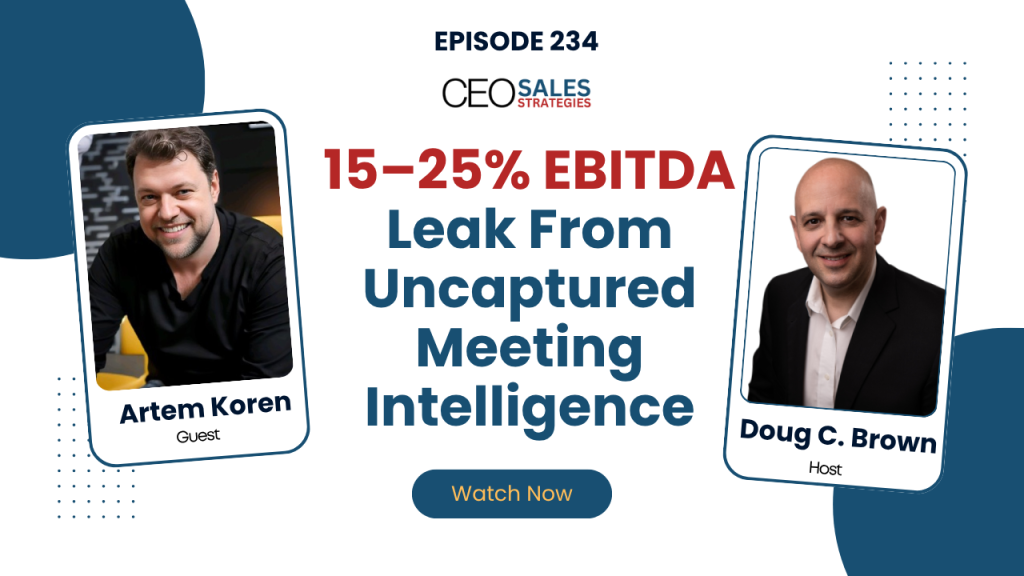
Most CEOs assume meetings are operational overhead, not a financial lever.
What’s actually happening is your highest-value data is being created and then lost, fragmented, or trapped in individuals instead of systems.
That loss shows up as slower execution, duplicated labor, and inconsistent customer outcomes—forcing buyers and investors to discount what looks like unstable performance.
By the time you see it in EBITDA or valuation, the inefficiency isn’t visible—it’s embedded across how your business runs.
Your close rates aren’t stuck because of weak delivery—they’re capped by how your buyers see themselves in the deal.
You can produce strong results, keep clients satisfied, and still get forced into price conversations, slow decisions, and low-leverage deals. When value isn’t experienced the way buyers define it, you don’t get premium positioning—you get tolerated.
That gap shows up in conversion rates, referral quality, and how repeatable your revenue actually is. Over time, it trains your market to treat you like a vendor, not a strategic partner—and that pressure flows straight into EBITDA and valuation.